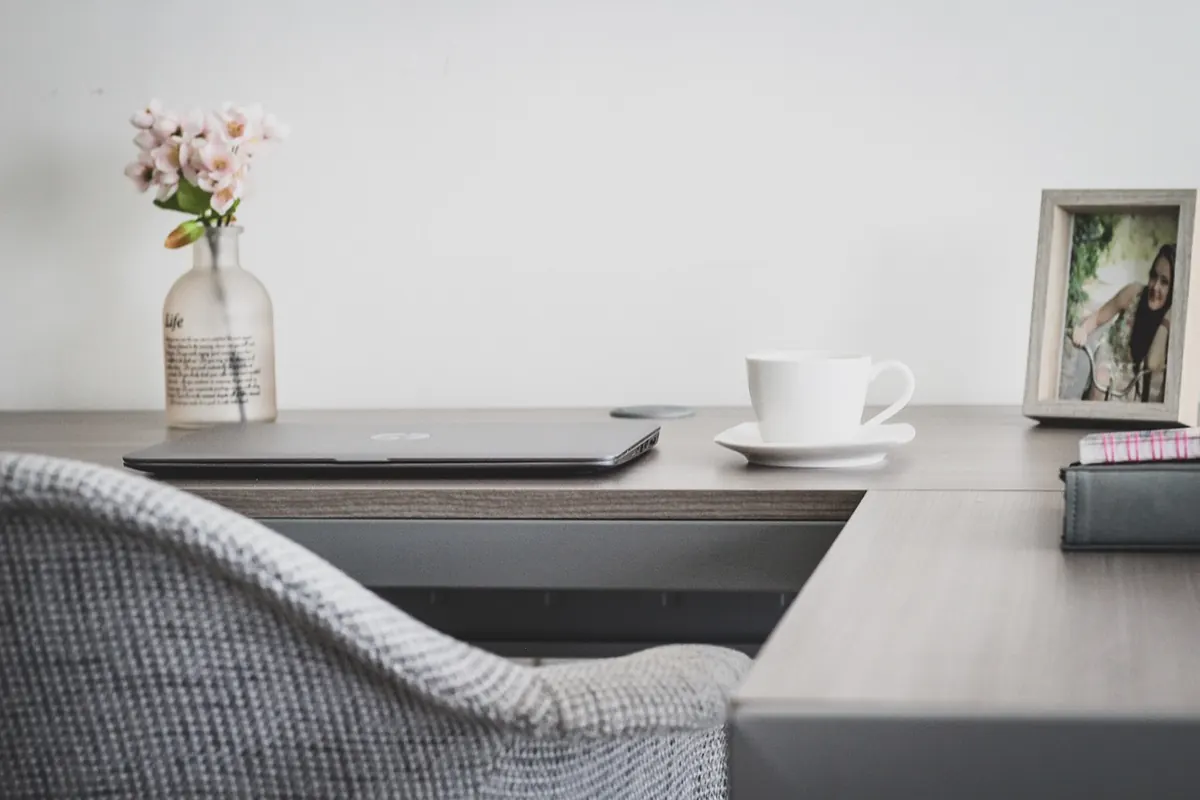
10 Common Mistakes to Avoid When Setting Up Your First Home Office
Most first home offices come together in a single weekend: a spare corner, a desk bought in a hurry, a chair borrowed from the kitchen. It works well enough for a month. Then the small irritations start — the glare on the screen at four o'clock, the ache between your shoulder blades, the cable you trip over every time you stand up. Almost all of it is fixable, and most of the fixes cost less than replacing the wrong thing. Here are the mistakes that come up again and again, and what to do instead.
Putting the desk somewhere before you know how you'll use it
The spare bedroom is usually the default, and it's often the right answer. But the exact wall you choose matters more than the room. Think about the three or four things you'll actually do there. If you're on video calls, your background is on show to colleagues all day, so a blank wall beats a doorway people walk through. If you spend hours on the phone to clients, a desk against a shared wall with a neighbour's television is a slow torture.
Two smaller checks are worth doing before you commit. Can you hear the front door, the washing machine, the road? And when you finish for the day, can you close a door on the work? In a flat where the desk shares a room with the sofa, tidying the surface into one drawer at the end of the day does more for your evenings than any accessory.
Getting the window wrong
A window is the best free light source in the house, and the easiest thing to get backwards.
- Window directly in front of you: you squint at the screen all afternoon, and on a call your face is a silhouette while the camera exposes for the bright window behind.
- Window directly behind you: light spills over your shoulder and reflects straight off the screen back into your eyes.
- Window to your side: usually the best option. Sit so the window is roughly at right angles to the desk, and fit a blind you can adjust as the sun moves round.
Then deal with the evenings. One overhead ceiling light alone puts your own shadow across the page or the keyboard. A single desk lamp, placed on the opposite side to your writing hand, fixes it. Look for a warm or neutral bulb rather than a cold blue one, particularly if you work late.
Treating the chair as an afterthought
People happily spend on the desk and then sit on whatever's left in the budget. It's the wrong way round. You'll spend more hours in the chair than touching anything else in the room. If you're buying second-hand — and there are good ex-office chairs about from businesses that have downsized — check that the gas lift still holds your weight, that the base doesn't wobble, and that the armrests fit under your desk. That last point catches a surprising number of people: a chair that won't slide in far enough leaves you reaching forward all day.
When you sit, aim for feet flat on the floor, thighs roughly level, and elbows at about a right angle. If your feet don't reach the floor, a footrest is a cheap, unglamorous improvement. If you already have back or neck trouble, speak to a physiotherapist or your GP about what suits your situation rather than relying on a product description.
Assuming a standard desk height suits you
Most desks sit at roughly the same height, which means they suit roughly average-height people. If you're shorter, the surface is probably too high and your shoulders creep upwards to compensate. If you're taller, your knees may not clear the underside. An adjustable chair solves most of it; a footrest helps the rest.
Measure before you buy, and measure three things:
- Depth. Around 60cm is the minimum. If you use a separate monitor and a keyboard, 70–80cm stops everything feeling crammed against the wall.
- Width. About 120cm is fine for a laptop and a notebook. Two monitors plus paperwork wants 140–160cm.
- Clearance. The gap between the floor and the underside of the desk has to fit your chair's armrests, and any drawer unit you plan to slide underneath.
Leaving power and cables until last
Cable chaos is the most predictable mistake on this list, and the easiest to avoid. Before the furniture goes in, count what needs plugging in: laptop, monitor, lamp, phone charger, printer, speakers, router. That's usually more sockets than the nearest wall provides, so plan for a surge-protected extension lead and fix it to the underside of the desk rather than leaving it on the floor.
Route cables down one leg and along the back edge, and use hook-and-loop ties rather than plastic zip ties — you will want to undo them. Also check your wi-fi before you build anything permanent. The far corner of a house, behind two walls, is exactly where video calls stutter. Test a call from the spot you've chosen; if the signal is weak, a mesh node, powerline adapters or a run of ethernet cable will save months of frustration. Keep the desk away from radiators and air vents, too, for your own comfort as much as the equipment's.
Underestimating storage and clutter
Desks don't stay clear on their own. Paper, cables, headphones, a mug, a stack of things that need filing — it all lands somewhere, and if there's no home for it, that somewhere is your keyboard. Fit one drawer or a small filing box, plus a shelf within reach, and you're most of the way there.
A useful trick: work for a fortnight with nothing but the basics, and watch where the mess actually accumulates. The left-hand corner that collects everything is telling you where the tray or drawer belongs. Buy for that, not for the tidy version of yourself you imagine.
Buying the entire setup in one go
A matching desk, chair, shelf and lamp bought on the same afternoon feels satisfying and rarely works. You don't yet know whether you want the monitor higher, the lamp closer, or a second surface for paperwork. Borrow and improvise first. A sturdy table from another room, a chair from the dining set and a lamp you already own will get you through the first few weeks while you learn what the space needs.
Spend in this order: chair, lighting, desk, then storage and accessories. Buying the small stuff last also means you buy less of it.
Starting with the bits that are hard to change
If you take one thing from all of this, make it the order of operations. Position the desk so the light comes from the side, and sort out power and your internet connection before anything is fixed in place. Then choose the chair, and only then the desk that fits both you and it. Everything else — the shelf, the plant, the cable tray — can wait until you've worked a few real weeks in the space and know what's annoying you.
That way you spend money on the two things you touch constantly, and nothing on the things you merely liked the look of online.
Photo: ricardorv30 / Pixabay